
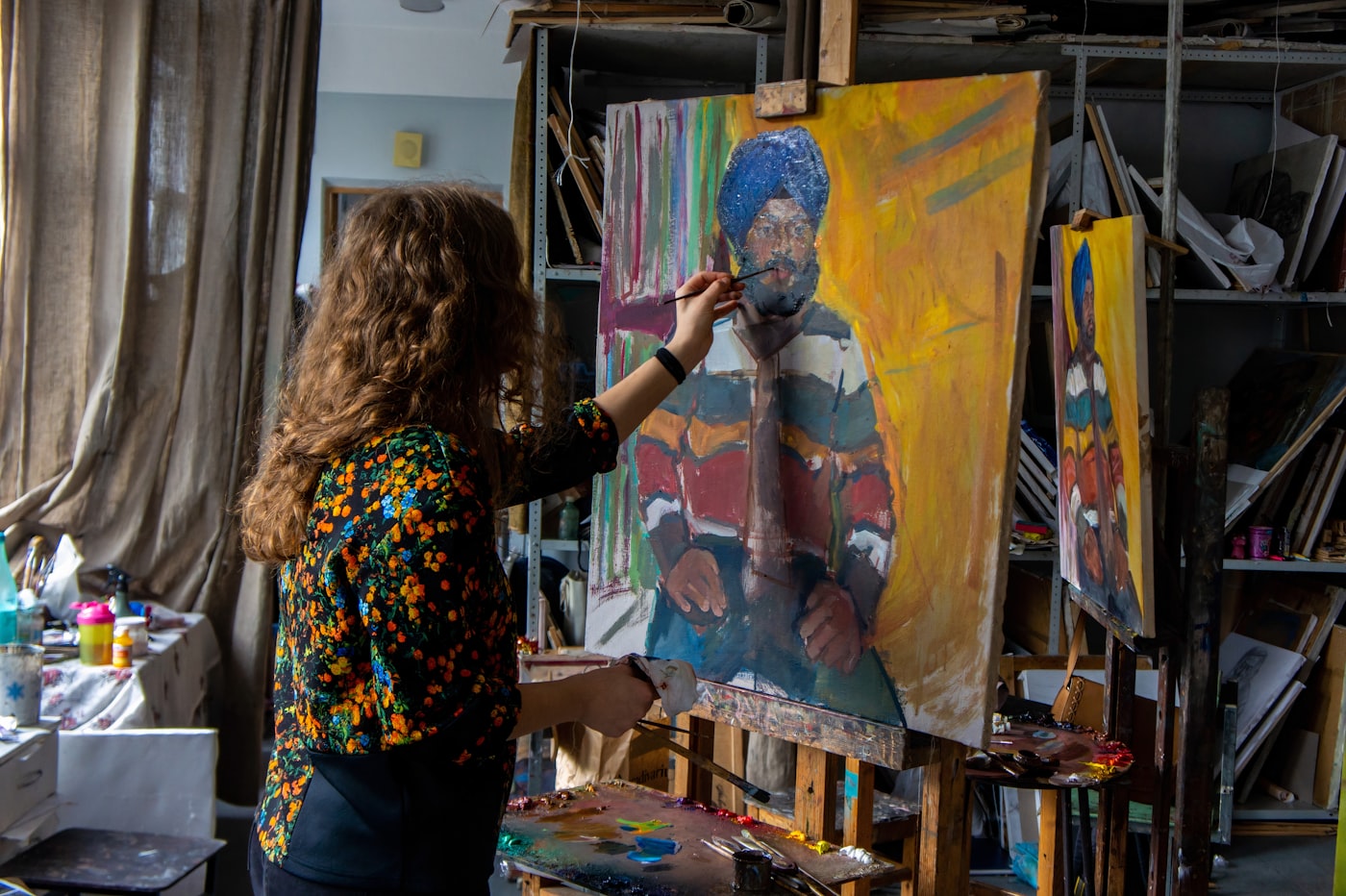
There is a stubborn cultural assumption that creativity is a young person’s domain, that originality belongs to the early years, and what comes after is consolidation, repetition, decline.
The data tells the opposite story.
Julia Child published her first cookbook at 49. Colonel Sanders franchised KFC at 62. Diana Nyad swam from Cuba to Florida at 64. Grandma Moses started painting at 78 and produced more than 1,500 works before she died at 101. Vera Wang designed her first wedding dress at 40 and built a global brand in her 50s. Toni Morrison published her first novel at 39 and won the Nobel at 62. Frank McCourt published Angela’s Ashes at 66.
These aren’t exceptions. Research now shows that the second half of life is, for many people, the creative half, once the noise of building a career and raising children quiets enough for the actual work to begin.
This article is for adults over 60 who feel a creative itch that has nothing to obvious to land on yet. It outlines seven paths to creative reinvention that consistently work, and three that consistently don’t.
New to the idea of intentional reinvention? Our free 5-day email course walks you through the same framework this site is built on. Start the free course →
By Sarah Macknaw, Lead Editorial Voice — Viva Horizon
Why the late-bloomer story is the real story
Economist David Galenson, in his influential research on creative careers, divides creators into two types:
Conceptual innovators peak young. Picasso. Mozart. They arrive with a vision largely formed and execute on it brilliantly in their twenties and thirties.
Experimental innovators peak late. Cézanne. Frost. Hitchcock. Their best work comes after decades of accumulating experience, observation, and craft, often in their 50s, 60s, and beyond.
Most adults are experimental innovators by temperament. The cultural focus on the first type, the prodigy, the youth, obscures the fact that the majority of significant creative work in human history has been produced by people over 40, and a substantial portion by people past 60.
Galenson’s data, replicated in studies from the National Bureau of Economic Research, confirms what biography has long shown: the late bloomer is not a rare miracle. The late bloomer is the norm.
Late-blooming creative achievement is a well-documented pattern in research on creative careers. Economist David Galenson’s analysis of major artists, writers, scientists, and entrepreneurs identifies two distinct creative arcs: “conceptual innovators” who peak in their twenties and thirties, and “experimental innovators” whose best work emerges after decades of accumulated experience, often in their 50s, 60s, and beyond. Examples include Julia Child publishing her first cookbook at 49, Frank McCourt writing Angela’s Ashes at 66, Grandma Moses beginning her painting career at 78, and Toni Morrison winning the Nobel Prize at 62. National Bureau of Economic Research data confirms that experimental creators substantially outnumber conceptual ones, making late creative reinvention the statistical norm rather than the exception. Neuroplasticity research from the National Institute on Aging further confirms that the brain retains significant capacity for learning, integration, and creative work well into old age.
What is rare is not the talent. What is rare is the willingness to begin again when you no longer have to.
The 7 identities worth exploring
These are the seven creative reinvention paths that, based on consistent patterns in the data and in biography, work for most adults who try them seriously. You don’t have to pick one. Most adults end up combining two or three.
The Maker
You spend the second half of life producing physical things with your hands. Woodworking. Pottery. Sewing and quilting. Cooking and baking at a serious level. Furniture restoration. Gardening as a craft, not a chore.
Why it works: Making activates motor cortex, problem-solving, and aesthetic judgment simultaneously. Research from the Mayo Clinic links craft activity in later life to a measurable reduction in cognitive decline. And the finished object, held, used, given, creates a tangible record of time spent well.
Where to start: Take one beginner class. Adult education centers, community colleges, and craft cooperatives all offer entry-level programs. Buy almost no tools until you’ve taken three classes.
The Storyteller
You take what you’ve witnessed in 60+ years and put it into permanent form. A memoir. A family history. A blog or substack. A podcast about a niche you love. Letters to your grandchildren collected over years.
Why it works: The Storyteller path uses your single most undervalued asset, the texture of lived experience, and turns it into something that outlasts you. Boston University and AARP both find that adults engaged in life-review and narrative practices show meaningful improvements in mood, identity coherence, and family closeness.
Where to start: Don’t try to write your full memoir. Write one scene. One vivid memory, two pages, written this week. See where it takes you.
The Teacher
You convert what you’ve learned into something you transmit. Mentoring. Volunteer instruction. Adult-ed teaching. Tutoring. Coaching. Running a small workshop or class.
Why it works: Encore.org’s longitudinal research on second-act careers shows that adults who teach in later life report some of the highest life-satisfaction scores of any group studied. The mechanism: teaching creates immediate purpose, builds connection, and re-anchors identity in contribution.
Where to start: Pick one skill you’ve earned. Offer to teach it, informally, for free, to one person, within the next month.
The Performer
You step in front of others. Theatre. Music. Storytelling slams. Community choirs. Stand-up classes. Improv. Even reading to children at the library.
Why it works: Performance demands presence and bodily engagement in a way few other activities do. Research from the Stanford Center on Longevity links performance-based activity to lower rates of depression and isolation in older adults, partly because performance is structurally social, you can’t do it alone.
Where to start: Audition for one community theatre production. Join one choir. Take one improv class. The terror is the point, it’s what reanimates parts of you that have been dormant.
The Builder
You start something, a small business, a side venture, a community project, a foundation, a nonprofit. The output isn’t art; it’s a system, an organization, an event series, a movement.
Why it works: Builders use accumulated network, judgment, and resources to create something that didn’t exist before. The Encore Career studies document thousands of adults who started ventures in their 60s and 70s, often the most meaningful work of their lives.
Where to start: Identify one problem you keep noticing in your community. Spend one weekend writing a one-page plan for what an answer would look like. Most never become reality. The 5% that do are often transformative.
The Healer
You convert later-life capacity for presence into practical care. Hospice volunteering. Doula work. Pastoral support. Health advocacy. Listening-based companionship for the lonely. Walking dogs at the shelter.
Why it works: Adults over 60 have, on average, a level of patience, equanimity, and non-anxious presence that younger caregivers often cannot match. The research on volunteer caregiving consistently finds it among the strongest predictors of later-life wellbeing, for the volunteer.
Where to start: Volunteer one shift at a hospice, hospital, shelter, or community organization. Notice whether it activates something in you. If yes, keep going.
The Apprentice
You become a serious beginner at something difficult. Not a hobby. A discipline. A musical instrument. A second language. A challenging physical practice, sailing, archery, ballroom, climbing. A genuinely demanding academic field, formally studied.
Why it works: Apprenticeship, the willingness to be bad at something on purpose, is one of the most cognitively and emotionally renewing activities available to adults. Neuroplasticity research consistently shows that the brain reorganizes when you learn skills that require sustained novel effort. Adults who apprentice late report a felt sense of expansion, not decline.
Where to start: Pick something you’ve always been curious about. Take ten weekly lessons. Don’t decide whether you “have talent” until then.
The 3 identities to avoid
These are the creative-reinvention paths that, based on consistent failure patterns, do not work. Adults who pour themselves into these tend to feel worse, not better.
The Influencer
The Influencer chases external validation, building an audience, becoming known, performing creativity online for a measurable response. Most adults over 60 who attempt this find themselves miserable within months. The dopamine economy of social media doesn’t reward what you actually have to offer; it rewards what already grabs attention. You will be competing on a field structurally rigged against you.
Real creative reinvention can include public sharing. But if the audience is the point, you’ll be chasing a moving target and feeling diminished along the way.
The Copycat
The Copycat finds someone who reinvented themselves brilliantly, a friend, a public figure, a memoirist, and tries to replicate their path. I’ll write a book like she did. I’ll learn pottery like he did. I’ll start a foundation like they did.
The form rarely transfers. What worked for them grew out of their specific history, network, values, and quirks. Built on someone else’s template, the reinvention stays hollow.
Use other people’s stories as illustrations, not templates.
The Procrastinator-Researcher
The Procrastinator-Researcher reads about creative reinvention. They take assessments. They subscribe to newsletters. They make lists of possible directions. They never do any of them.
This is the most common failure pattern of all, and the most easily missed, because it feels like work. It isn’t. It’s a sophisticated form of avoidance.
The cure is the same as it always is: pick one thing, do it badly for two weeks, see what happens.
Creative reinvention is one path to a fuller life after 60. See how it connects to the bigger picture in How to Find Purpose After Retirement, or start smaller with The 25-Minute Morning Routine.
The test for a real direction
When you find a creative path worth pursuing, three things tend to be true.
- You notice time differently when you’re doing it. Hours pass that felt like minutes, what psychologists call “flow.” If you’ve experienced this in even a small dose, pay attention.
- You’re willing to be bad at it. Real reinvention requires apprenticeship. If you can only enjoy something when you’re already good at it, you’ll never reinvent.
- It connects to something larger than itself. A relationship, a cause, a craft tradition, a community, a sense of legacy. Pure self-expression rarely sustains over years; meaningful expression does.
If a candidate path meets all three, treat it seriously.
A 60-day experimentation plan
You don’t decide your reinvention. You experiment your way into it.
Days 1–14: Pick three of the seven identities above that draw you most. List one concrete action for each, a class, a meeting, a first attempt.
Days 15–28: Take all three actions. Don’t commit. Just sample.
Days 29–42: Pick the one that felt most alive. Go deeper. Take a second class. Have a longer conversation. Produce something.
Days 43–60: Decide whether to commit to a six-month exploration. Six months is the minimum to know whether something is real or a passing interest.
That’s it. Sixty days. Not a reinvention, the threshold of one.
Frequently asked questions
Am I really too old to reinvent at 70 or 75?
No. The neuroplasticity research is unambiguous: the brain retains substantial capacity for learning, creativity, and reorganization throughout life. The constraint is rarely capacity. It is willingness to begin badly.
What if I don’t think I’m creative?
Most adults don’t think they are. Most adults are wrong. “Creative” is not a personality trait limited to artists; it is what happens when you put serious sustained attention on anything for long enough. The bottleneck is attention, not talent.
What if I don’t have money to invest in a new direction?
Most of the paths above can be started for under $100. Libraries, free online resources, volunteer roles, beginner classes, and community organizations are widely available. Lack of money is rarely the actual obstacle.
What if my spouse isn’t supportive?
This is a real challenge, and worth a real conversation. Many spouses become threatened when one partner reinvents and the other stays static. The path forward is rarely to abandon the reinvention; it’s to invite your spouse into a parallel exploration, even if they’re skeptical at first.
How do I know when I’ve found the right direction?
You won’t, completely, for a year or more. Real reinvention emerges slowly. The early signs: you wake up looking forward to it. You don’t have to talk yourself into it. You’re willing to be bad at it. Time changes its texture when you’re doing it.
The bottom line
Creative reinvention after 60 is not a fantasy reserved for the famous, the wealthy, or the lucky. It is the well-documented norm, what happens to adults who are willing to begin again when nothing is forcing them to.
The seven paths above are the ones that consistently work. The three identities to avoid are the ones that consistently don’t. Beyond that, the path is yours to walk, slowly, awkwardly at first, then with increasing confidence as the new identity takes hold.
You are not too late. You are not too tired. You are not done.
You are, statistically and biologically, somewhere near the start of what could be your most creatively productive period yet.
Creative reinvention after 60 follows seven well-documented paths that consistently produce meaningful renewal: the Maker (craft-based hands-on work), the Storyteller (memoir, family history, narrative practice), the Teacher (mentoring and instruction), the Performer (theatre, music, public expression), the Builder (small ventures, organizations, community projects), the Healer (caregiving and presence-based volunteer work), and the Apprentice (becoming a serious beginner at something difficult). Three patterns consistently fail: chasing audience validation (the Influencer trap), copying someone else’s reinvention path (the Copycat trap), and researching reinvention as a substitute for practicing it (the Procrastinator-Researcher trap). Late-blooming creative achievement is statistically the norm, supported by research from David Galenson’s work on creative careers, the National Bureau of Economic Research, and neuroplasticity research from the National Institute on Aging.
Ready to start experimenting?
For the full system, The Reinvent After 60 Playbook includes deeper exercises for each of the seven identities, plus stories of six adults who built second-act creative lives after 60. $47, instant download.
Your next horizon may be the most original work you’ve ever done.
Sarah
Sarah is the lead editorial voice of Viva Horizon. She writes about the psychology and practice of reinvention after 60, drawing on research from Boston University, MIT AgeLab, and interviews with hundreds of retirees navigating this transition.
Last updated: August 2026
Found a direction from this list, or discovered your own? I’d love to hear what you’re exploring. Write to me directly at [email protected].
— Sarah